Ian Carmichael
Director - Notre Dame Radiation Laboratory
University of Glasgow, Scotland, B.Sc.Hons (1971) Ph.D. (1974)
Phone: (574) 631-4502
Email: carmichael.1@nd.edu
Office: 321 Radiation Research Building
Theoretical Studies of Reactive Intermediates
Scientific Interests
Quantum Chemistry of Reactive Intermediates
Structure and properties of radicals, radical ions, and excited states in solution and on surfaces.
Magnetic Interactions in Molecular Species
EPR splittings; NMR spin-coupling constants and chemical shifts; nuclear quadrupolar couplings.
Theory of Radiation and Photochemical Transformations
Photophysical processes; dissociative electron attachment; transient absorption spectroscopy.
Radiation Damage in Macromolecular Crystallography
Specific damage mechanisms and mitigation strategies.
Recent Accomplishments
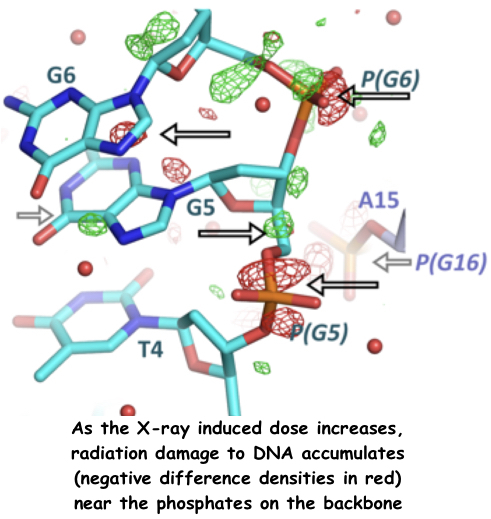
Radiation damage in MX
Systematic investigation of radiation damage to a crystal of a DNA 16-mer diffracting to 1.8 Å and held at 100 K, was probed up to an absorbed dose of 45 MGy. The DNA crystal was found to be fairly radiation insensitive to both global and specific damage.
In terms of specific damage, the regions of DNA found to be particularly susceptible were those associated with certain bound calcium ions, sequestered from the crystallization buffer. Damage was particularly evident in electron density maps around the backbone phosphate groups, appearing on the nucleobases only at the highest doses.
Understanding dissociative electron attachment
Despite decades of gas-phase studies on dissociative electron attachment (DEA) to various molecules, as yet there has been no direct detection and characterization of the neutral radical species produced by this process. We use stepwise electron spectroscopy to directly measure and characterize the neutrals produced upon zero-electron-energy DEA to a model molecule, carbon tetrachloride. We observe the direct yield of the trichloromethyl radical and measure the appearance energies of all the other neutral species. Combined with high-level quantum chemical calculations this allows a comprehensive analysis of both the initial DEA event and the subsequent electron-impact ionizations under single-collision conditions. This work paves the way toward a complete experimental characterization of DEA processes, in turn providing a refined understanding of the low-energy electron-induced formation of radical species.
NMR spin couplings in biomolecules
NMR J-couplings measured by selective 13-C labeling of twelve, structurally-diverse,β(1→4) linked disaccharides were analyzed using parametrized equations obtained from density functional theory calculations, coupled with Fredholm theory and circular statistics. Our statistical program, MA’AT, allowed the modeling of the linkage torsional parameters, phi (φ) and psi (ψ),as a single von Mises distribution with mean positions in close accord to those of rotamer populations obtained from 1 μs aqueous molecular dynamics (MD) simulations and crystallographic database statistical analyses. An experimental means to validate the conformational preferences predicted from MD simulations is thus established.
Selected Publications
Das, L.; Guerin, S.J.; Bruggeman, C.; Carmichael, I. and Bartels, D.M. “Unexpected radiation chemistry of borate buffer: II. Second order decay.” J. Phys. Chem. B (2026) 130, 8227-40 link
Kharchilava, G.; Finley, J.; Chakraborty, D.; Carmichael, I. and Ptasińska, S. “Ion yields and velocity map imaging of electron attachment-induced fragmentation of linear dialkyl carbonates: Exploring dissociation patterns and mechanism.” Eur. Phys. J. D (2026) 80 link
Zhang, W.; Meredith, R.J.; Lin, J.; Carmichael, I. and Serianni, A.S. “Bisecting βGlcNAc: MA’AT analysis of 13C-labeled oligosaccharides containing βGlcNAc-(1→4)- βMan O-glycosidic linkages. J. Biol. Chem. (2026) 302 link
Das, L.; Guerin, S.J.; Carmichael, I. and Bartels, D.M. “Unexpected radiation chemistry of borate buffer: I. First-order scavenging of OH radicals” J. Phys. Chem. B (2025) 129, 4982–95 link
Finley, J.; Kharchilava, G.; Carmichael, I.; Chakraborty, D. and Ptasińska, S. “Dissociation of gas-phase anisole induced by low-energy electron interactions: understanding patterns of aromatic bond cleavage.” Physica Scripta(2025) 100, 045402 link
Paul, A.; Slaughter, D.S.; Ptasińska, S.; Nandi, D.; Carmichael, I.; Gorfinkiel, J.D. and Chakraborty, D. “Fragmentation dynamics through geometrical distortion in low-energy electron attachment to carbon disulfide” Phys. Rev. A (2025) 111, 042804 link